
Bill Gasiamis works with leaders, teams, and organisations to identify what’s driving conflict, disengagement, and cultural breakdown — and gives them a clear path forward. Speaking and consulting for teams that need to perform.

Between 2012 and 2014, Bill Gasiamis experienced three haemorrhagic strokes and underwent brain surgery. What he discovered in recovery wasn’t just how to heal — it was how people actually behave when the stakes are real. How fear shapes decisions. How pressure exposes the gaps between who we think we are and how we actually show up. How the difference between a team that holds together and one that fractures is rarely about capability — and almost always about behaviour.
That understanding is the foundation of everything Bill does with leaders and teams today.
Most leaders know something isn’t right. The team looks functional on paper — but trust is thin, communication is strained, and performance has quietly plateaued. The problem isn’t effort. It’s visibility.

Leaders need more than motivation. They need tools that reveal what’s actually happening and a perspective that helps them grow through disruption rather than manage around it.
A keynote or workshop that gives your team a new lens on behaviour, pressure, and what it takes to perform together. Practical, direct, and designed to open a conversation — not close one.
A structured engagement that makes the behavioural dynamics affecting your team visible — and gives you a clear, evidence-informed path to address them. Built for organisations that need to act on what they find.
Because lived experience and evidence-based tools are more useful together than either one alone.
Most teams don’t have a capability problem. They have a visibility problem. When you can see what’s actually driving behaviour, you have something real to work with.
The tools Bill uses surface how people think, communicate, and lead under pressure — giving individuals and teams the specific awareness they need to work better together.
When people feel understood rather than managed, they commit to outcomes — not just tasks. That shift is what makes performance durable.
The goal isn’t a workshop spike. It’s a team that knows how to navigate the next disruption without falling apart.
Between 2012 and 2014, Bill experienced three haemorrhagic strokes and underwent brain surgery. He woke up unable to walk, with no certainty about what his life would look like — or whether it would look like anything at all.
What he discovered in recovery changed the way he understood human performance. Not just the physical work of healing, but the harder work of navigating fear, uncertainty, and the gap between who you thought you were going to be and who you actually are under pressure.
Today, Bill works with leaders, teams, and organisations across Australia as a keynote speaker and accredited behavioural consultant — bringing a perspective on performance under pressure that is both deeply personal and evidence-informed.
He is the author of two books: You Will Not Always Feel Like This, a guide to post-traumatic growth grounded in the research of Tedeschi and Calhoun; and The Unexpected Way That a Stroke Became the Best Thing That Happened, his account of recovery and personal transformation after three brain haemorrhages.
Practical perspectives on workplace behaviour and team performance.
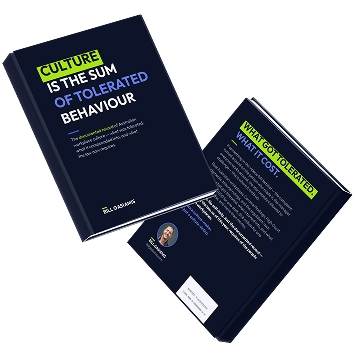
The documented record of Australian workplace culture—built from coronial findings, court judgments, and regulators’ files. No advice, no villains, no opinions. Just what was tolerated, what it compounded into, and what the law now requires.
The documented record of Australian workplace culture—built from coronial findings, court judgments, and regulators’ files. No advice, no villains, no opinions. Just what was tolerated, what it compounded into, and what the law now requires.
This following document sets forth the Privacy Policy for this website.
We collect Non-Personally Identifiable Information from visitors to this Website. Non-Personally Identifiable Information is information that cannot by itself be used to identify a particular person or entity, and may include your IP host address, pages viewed, browser type, Internet browsing and usage habits, advertisements that you click on, Internet Service Provider, domain name, the time/date of your visit to this Website, the referring URL and your computer’s operating system.
Participation in providing your email address in return for an offer from this site is completely voluntary and the user therefore has a choice whether or not to disclose your information. You may unsubscribe at any time so that you will not receive future emails.
Your personal information that we collect as a result of you purchasing our products & services, will NOT be shared with any third party, nor will it be used for unsolicited email marketing or spam. We may send you occasional marketing material in relation to our design services.
If you choose to correspond with us through email, we may retain the content of your email messages together with your email address and our responses.
Some of our advertising campaigns may track users across different websites for the purpose of displaying advertising. We do not know which specific website are used in these campaigns, but you should assume tracking occurs, and if this is an issue you should turn-off third party cookies in your web browser.
As you visit and browse Our Website, the Our Website uses cookies to differentiate you from other users. In some cases, we also use cookies to prevent you from having to log in more than is necessary for security. Cookies, in conjunction with our web server log files or pixels, allow us to calculate the aggregate number of people visiting Our Website and which parts of the site are most popular.
This helps us gather feedback to constantly improve Our Website and better serve our clients. Cookies and pixels do not allow us to gather any personal information about you and we do not intentionally store any personal information that your browser provided to us in your cookies.
P addresses are used by your computer every time you are connected to the Internet. Your IP address is a number that is used by computers on the network to identify your computer. IP addresses are automatically collected by our web server as part of demographic and profile data known as traffic data so that data (such as the Web pages you request) can be sent to you.
We do not share, sell, lend or lease any of the information that uniquely identify a subscriber (such as email addresses or personal details) with anyone except to the extent it is necessary to process transactions or provide Services that you have requested.
You may request access to all your personally identifiable information that we collect online and maintain in our database by using our contact page form.
We reserve the right to make amendments to this Privacy Policy at any time. If you have objections to the Privacy Policy, you should not access or use this website. You may contact us at any time with regards to this privacy policy.
Practical perspectives on workplace behaviour, team culture, and what Australian employers need to know about psychosocial hazard compliance. No sales emails — just useful content.
