


Introduction
“She said she was being bullied. She said it loudly, clearly, and repeatedly. She was not believed.”
A Victorian Coroner’s inquest finding handed down in May 2026 found that The Good Guys failed to respond appropriately to the complaints of a worker who had been progressively isolated, belittled, and ignored after sustaining a workplace injury in 2018. The Coroner’s own words are stark: the employee “loudly, clearly and repeatedly alleged she was bullied, was not believed and was regarded as difficult.”
This is not a story about procedural gaps. The Good Guys had procedures. This is a story about what happens when a culture protects itself — and when every layer of an organisation collectively decides, through behaviour, that the person raising the complaint is the problem.
In this article, you will learn:
- The specific facts the Coroner identified as failures by The Good Guys
- Why the cultural dynamics that silenced this complaint are common across Australian workplaces
- What the global engagement data tells us about why organisations dismiss rather than investigate
- What this finding signals about how coroners and regulators are now framing employer accountability
- What every Australian employer needs to understand about their duty to investigate with genuine intent
What the Coroner Actually Found
The case centres on a worker who sustained a physical injury at The Good Guys in 2018 and was subsequently placed on light duties. Reporting by EEO Specialists and the OHS Reps network documents the Coroner’s finding in detail. What followed her injury was a sustained pattern of workplace conduct that the Coroner found constituted bullying: progressive isolation from her team, belittlement, and being treated as a problem rather than a person in distress.
Critically, the employee raised her concerns repeatedly. She did not make a single complaint and fall silent. She raised the issue loudly and clearly across multiple interactions — and was, according to the Coroner’s finding, not believed and regarded as difficult by the organisation. The complaint was treated as noise rather than signal. And the culture that produced the conduct continued uninterrupted.
The Coroner found that The Good Guys “failed to respond appropriately” to the repeated bullying complaints. That language is significant: it is not a finding that the organisation lacked policies. It is a finding that the response to an identified risk was inadequate — and that inadequacy contributed to a preventable outcome.

Why Policies Failed Where Culture Failed Too
The most common misreading of findings like this one is to treat them as a process problem. Organisations respond by updating their grievance procedures, retraining their HR teams, adding steps to their investigation flowcharts. None of that would have changed what happened here.
The failure identified by the Coroner is cultural. The investigation process — whatever form it took — was biased toward the collective account of the team over the individual’s account of her experience. That is not a policy failure. That is a behaviour pattern. It lives in the way managers run conversations, the way complaints get escalated, and the way an organisation collectively decides whose reality is credible.
Victim-blaming — being “regarded as difficult” for raising a legitimate concern — is not an aberration in toxic cultures. It is a feature. It is how cultures that have normalised harmful behaviour protect that behaviour from scrutiny. A person who complains repeatedly in the face of disbelief is not being difficult. They are escalating because the system is not working. The organisation’s response to that escalation determines whether they are protected or further isolated.
The Good Guys had an opportunity at every interaction to change the trajectory. The culture made a different choice — not as a single decision, but as an accumulation of individual behaviours that collectively dismissed a person in distress.
The Broader Pattern
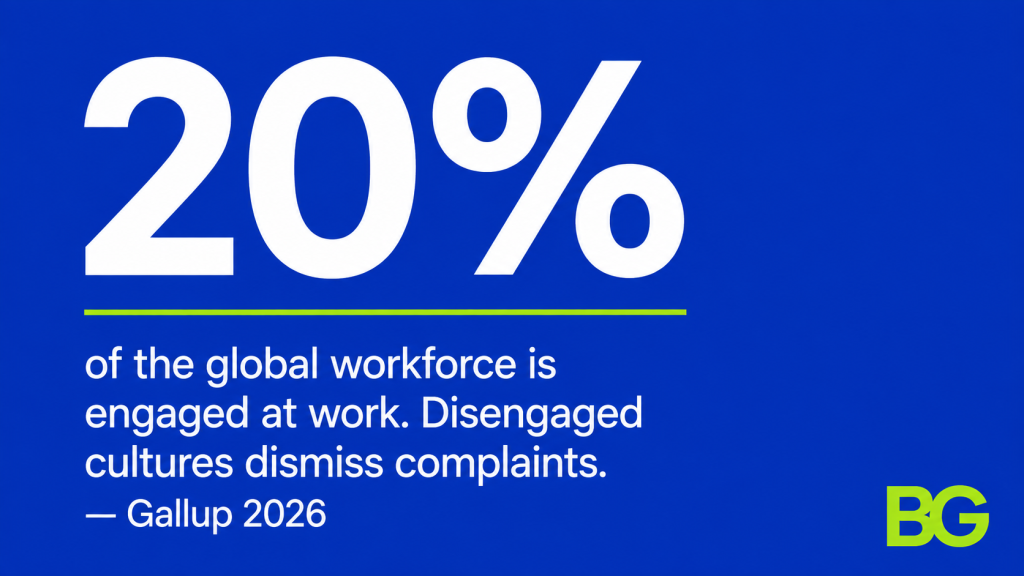
Gallup’s 2026 State of the Global Workplace report confirms that this dynamic is not unique to retail environments or Australian organisations. Only 20% of the global workforce is engaged at work — the second consecutive annual decline. In disengaged cultures, the social contract between managers and employees breaks down. Managers under pressure prioritise cohesion and performance over individual complaints. Organisations default to protecting the group over investigating the individual.
In Australia specifically, Gallup’s data shows 49% of workers experienced significant daily stress in the past year — nine points above the global average. Elevated stress across a workforce increases the likelihood that individual distress signals will be normalised rather than investigated. The person presenting with distress gets labelled as difficult. The behaviour producing the distress remains invisible.
This is not a pattern unique to large retailers. It operates in professional services firms, government departments, healthcare organisations, and small businesses. What varies is the accountability consequences when it surfaces — and in 2026, those consequences increasingly include coronial inquests that find the employer’s name in the finding.
What Leaders Need to Understand
The most important shift in how Australian regulators and coroners are framing employer accountability is this: having a complaints process is no longer sufficient. What is being examined is what actually happens when someone uses it.
An investigation process that is biased toward the collective over the individual is not a genuine investigation. A culture that labels persistent complainants as “difficult” is not a culture that takes complaints seriously. The procedural documentation exists — and the Coroner finds the failure anyway, because the failure was in the conduct, not the paperwork.
Every Australian employer with a grievance policy should be asking a different question. Not “do we have a process?” but “what does our culture actually do when someone walks through the door with a complaint?” The answer is revealed not in the policy document, but in the behaviour of every manager in the chain — from the direct supervisor who first heard the complaint to the senior leader who determined how seriously it was investigated.
Understanding and addressing behavioural patterns in leadership before they produce coronial outcomes is not optional. The tools that surface these patterns — including structured behavioural assessment — exist precisely to make visible what standard investigations miss.
Conclusion
The Coroner’s finding in this case is precise: The Good Guys failed to respond appropriately to repeated bullying complaints. The standard is not perfection. The standard is an appropriate response — and appropriate means genuine, unbiased, and proportionate to the severity of what is being raised.
What makes this finding significant is not that a workplace had a bullying problem. It is that the system designed to address the problem became part of the problem. The culture protected itself, and the employee bore the consequences.
Australian employers who read this finding as a retail sector problem or a size-of-organisation problem are misreading it. The mechanisms that produced this outcome — dismissal of complaints, bias toward collective accounts, labelling of complainants — are present in workplaces of every kind. The question is not whether they exist. It is whether anyone is looking for them.
Is Your Culture Protecting Itself?
Coronial findings don’t happen overnight. They are the endpoint of a pattern that was visible long before it became fatal. Bill works with organisations to identify the behavioural patterns that create psychosocial risk — before they become the subject of an inquest.