


Quick Answer
Clinical research on everyday sadism in the workplace — a measurable personality trait involving deriving pleasure from others’ suffering — shows it’s overrepresented in leadership populations and drives a recognisable pattern of workplace bullying: persistent humiliation, denial when confronted, and behaviour that escalates when the person feels institutionally protected. Standard HR investigations are structurally poor at catching it, since they rely on self-report and witness corroboration, both unreliable with these traits. A structured behavioural psychometric assessment, like Entrepleio®, surfaces the underlying pattern before it ever reaches a formal complaint.
Introduction
Behavioural assessments don’t just measure strengths. They reveal the patterns organisations are most afraid to name.
Recent reporting in Psychology Today Australia — drawing on published clinical studies — has brought renewed attention to “everyday sadism” as a workplace bullying driver. The research is specific: everyday sadism is a measurable personality trait characterised by deriving pleasure from another person’s suffering. It manifests in workplaces through persistent patterns of humiliation, degradation, public shaming, and intimidation. And it is far more common in leadership populations than organisations acknowledge.
In this article, you will learn:
- What the clinical research on everyday sadism identifies as the key workplace indicators
- Why these patterns survive — and are often protected by — standard HR investigation processes
- How this connects to the broader accumulation of Australian workplace harm data
- What a structured behavioural psychometric assessment surfaces that investigations cannot
- What a 60-minute Entrepleio® session reveals — and why it is the starting point, not the end point
What Everyday Sadism Looks Like in a Workplace
Psychology Today’s analysis of the published research identifies several consistent behavioural indicators of everyday sadism in professional settings: repeated aggressive or demeaning conduct that persists outside periods of workplace stress, lack of empathy for the person targeted, active minimisation of the harm caused (“you’re being oversensitive,” “that’s just how I operate”), and a pattern of behaviour that intensifies when the perpetrator perceives they are protected by institutional authority or social status.
Critically, the research notes that perpetrators frequently — and convincingly — deny or minimise their conduct when confronted. This is not strategic deception in most cases. It reflects a genuine lack of recognition of the harm being caused, combined with a strong drive to maintain status and avoid accountability.
This makes formal investigation processes structurally ill-suited to addressing the behaviour. An investigation relies on the perpetrator’s self-report and the ability of witnesses to provide corroborating accounts. Neither is reliable in the presence of these traits.

Why HR Investigations Miss Everyday Sadism in the Workplace
The standard HR investigation process was designed to establish whether a specific policy was violated. It was not designed to identify underlying behavioural traits in the people named in the complaint.
An investigation asks: did this event happen? It does not ask: what does the behavioural pattern of this person look like across contexts, over time, under pressure? Those are different questions — and the second question is the one that matters for prevention.
In cases involving everyday sadism, the perpetrator is often a socially skilled individual with genuine institutional authority and a long record of performance delivery. The complaints against them are typically characterised as interpersonal conflict rather than systematic harm. The investigation resolves in a mediation or a “both sides” finding. The person continues in their role. The person they harmed leaves.
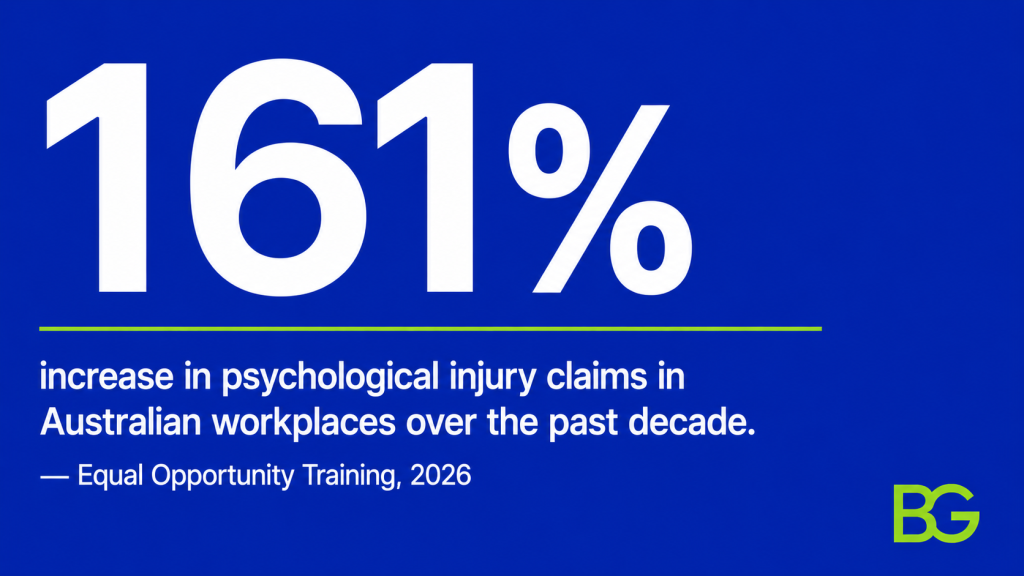
This pattern repeats across Australian organisations every week. The $1 billion in annual psychological injury costs, the 161% growth in claims over a decade, the near-seven-year high in misconduct reports — these are not produced by unknown or unpredictable conduct. They are produced by identifiable traits, in identifiable people, operating in organisations that have no mechanism to see them.
The Broader Pattern
The clinical literature on dark-triad adjacent personality traits — which includes everyday sadism alongside psychopathy and Machiavellianism — is clear on one consistent finding: these traits are overrepresented in leadership populations relative to the general population.
That is not a judgement. It is an empirical observation. The traits that help some people reach leadership positions — risk tolerance, confidence, willingness to compete aggressively — overlap with the trait spectrum that, at the upper end, produces the patterns documented in the research.
Gallup’s 2026 State of the Global Workplace report found that 40% of workers globally experienced significant stress the previous day. In Australia and New Zealand, that figure is 49%. The elevated stress is not random. It is produced by the human environment of work — the managers and leaders whose behavioural patterns are, in most organisations, entirely unmeasured.
What Behavioural Assessment Actually Surfaces
Entrepleio® is a ten-facet behavioural psychometric that maps individual leadership patterns across ten dimensions drawn from the Enneagram and clinical psychology. It does not produce a personality type. It produces a behavioural profile — including the patterns that are most likely to be active under pressure, most likely to affect team dynamics, and most likely to go unrecognised by the individual themselves.
In a 60-minute exploration session with Bill, a leadership team member or executive receives a full debrief of their assessment — not as a performance review, but as a behavioural mirror. The session surfaces the patterns that, in clinical terms, are closest to the everyday sadism end of the spectrum: dominance, control, status protection, low empathy, avoidance of accountability. And it creates the conditions for those patterns to be addressed rather than continued.
This is not a replacement for HR process. It is the preventive layer that HR process does not provide. It is the conversation that happens before the complaint is lodged, before the investigation is ordered, before the tribunal convenes.
For organisations that have already been through one investigation and are wondering how to prevent the next one, a structured Entrepleio® assessment of the relevant leadership cohort is the most direct available intervention.
Conclusion
The research on everyday sadism in the workplace confirms what Australian compensation data, coroner’s inquests, and workplace litigation have been documenting for years: harmful leadership behaviour follows identifiable patterns. It can be measured. It can be surfaced. It can be addressed.
The organisations that will change their outcomes are the ones that stop relying solely on investigation and start investing in the visibility that prevents harm from reaching that threshold.
The Entrepleio® assessment is where that work begins. DM Bill to find out what a 60-minute session would reveal about your leadership team — or book a strategy call at billgasiamis.com/consulting.
Is Your Organisation Exposed?
Every major Australian workplace harm story this year started with a leader whose behavioural patterns were never made visible. An Entrepleio® session with Bill takes 60 minutes and reveals what most organisations spend years managing after the fact. Book now and see what yours shows.