


Introduction
New NSW workers compensation reforms have just made it significantly harder to claim compensation for psychological injury. That is not the same as making it easier to create psychological harm without consequence.
Legislation confirmed by reporting from Herbert Smith Freehills Kramer and Law Partners takes effect 1 July 2026. It represents the largest single change to NSW psychological injury compensation in a generation: new thresholds for accessing damages, tighter definitions of compensable events, and shorter payment windows for most claims. For organisations managing a compensation budget, some of this reads as welcome news.
The misreading of this reform — one that carries significant legal risk — is the assumption that a narrower workers’ compensation pathway means reduced overall exposure to psychological injury liability. It does not. The WHS prosecution pathway, which runs independently of the workers’ compensation system, is simultaneously widening. These are two different legal tracks, and the organisations that treat the comp reform as a risk management win are misunderstanding the landscape.
In this article, you will learn:
- The specific changes introduced by the NSW workers compensation reforms for psychological injury from 1 July 2026
- Why the compensation pathway reform does not reduce WHS prosecution exposure
- What SafeWork NSW’s parallel enforcement activity means for organisations operating in NSW
- How Gallup’s 2026 global data frames the management gap that creates the underlying risk
- What genuine risk management looks like when both exposure pathways must be managed simultaneously
What Changed Under the NSW Workers Compensation Reforms
The legislative changes reported by Herbert Smith Freehills Kramer are specific and significant. From 1 July 2026, workers claiming workers’ compensation for psychological injury in NSW must demonstrate that a “relevant event” — defined as a specific incident such as workplace bullying, harassment, or exposure to traumatic events — was the main contributing factor to their injury. Prior to this change, a broader range of psychological harm was potentially compensable.
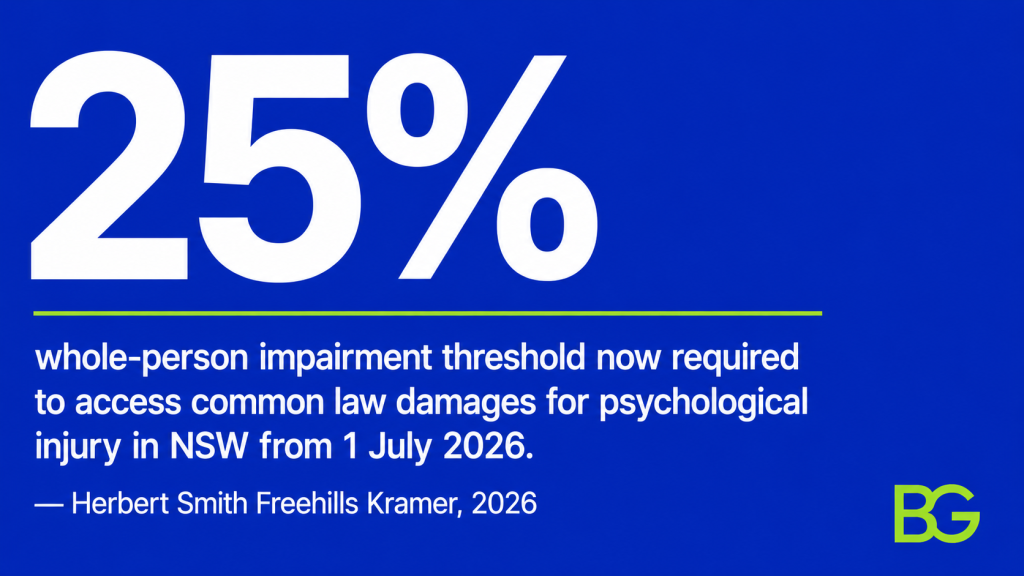
Access to common law damages — which can include compensation for pain and suffering and economic loss beyond basic wage replacement — is now gated behind a 25% whole-person impairment threshold. This is a significant increase on the previous standard, and in practice will exclude many psychological injury claims from common law proceedings.
Weekly compensation payments are now capped at 130 weeks for most psychological injury claims, with limited pathways to continued payments beyond that period. For organisations managing long-duration claims — which psychological injuries often are, given they result in recovery periods nearly five times longer than physical injuries on average — this change reduces long-term financial exposure.
Taken together, the reforms narrow the workers’ compensation pathway for psychological injury in NSW. They do not extinguish it, and they do not touch the separate legal obligation under WHS legislation to prevent psychological harm in the first place.

The Parallel Enforcement Track
At the same time these workers’ compensation reforms are reducing the compensation exposure for psychological injury, SafeWork NSW has significantly increased its enforcement capacity in the WHS space. Twenty inspectors with a specific psychosocial mandate have been appointed. A November 2025 compliance blitz produced more than 700 non-compliance notices, including 228 psychosocial-specific checks. SafeWork has explicitly stated it is moving toward prosecutions.
These two developments — narrower compensation exposure, wider prosecution exposure — are happening simultaneously. An organisation that reads the workers’ comp reform as a signal that psychosocial risk management is less pressing is doing the opposite of what the combined legal landscape requires.
WHS prosecution is not constrained by the changes to workers’ compensation. A regulator can prosecute an employer for failure to manage psychosocial risk regardless of whether the affected worker successfully makes a compensation claim. The prosecution standard is the employer’s conduct — did they identify the risk, did they take steps to eliminate or minimise it, did they respond appropriately when harm occurred? These questions are answered independently of whether the workers’ compensation system pays out.
In cases like the Department of Defence conviction in December 2025 — the first Commonwealth employer conviction for failing to manage psychosocial risks — the prosecution did not depend on a successful compensation claim. It depended on the employer’s conduct in the face of an identifiable risk. That standard applies equally in NSW.
The Broader Pattern
Gallup’s 2026 State of the Global Workplace report frames the management gap that underlies both exposure pathways. Manager engagement has declined 9 points globally since 2022. Seventy-eight percent of managers globally are not engaged at work. In this context, the psychosocial risks that produce both compensation claims and WHS prosecutions — bullying, harassment, excessive demand, poor role support, inadequate manager response to distress — are not aberrations. They are the predictable output of a global management landscape where the skills and engagement needed to prevent them are in decline.
The legislative and regulatory response to this pattern — tighter compensation, more aggressive prosecution — is the enforcement system adjusting to a crisis in workplace culture that the management practices of the past decade have produced. The organisations that understand this frame the reform correctly: not as reduced liability, but as a redistribution of liability toward a track that carries criminal consequences.
What the Workers Compensation Reforms Mean for Employers Now
The practical implication of the July 2026 reforms, combined with SafeWork’s enforcement escalation, is that prevention is now the only risk management strategy that addresses both exposure pathways simultaneously.
A robust workers’ compensation management program reduces financial exposure from successful claims. A psychosocial risk prevention program reduces WHS prosecution exposure. These are different programs addressing different legal risks. Organisations that have one without the other are not fully managing their liability.
What prevention looks like in practice is manager capability. Not documentation of psychosocial hazards, though that is required. Not a grievance procedure, though that is required. Prevention is: managers who can identify psychosocial hazards when they present, who know how to respond to distressed team members, who understand their duty to intervene before harm escalates, and who have the awareness to recognise their own behaviours as potential risk factors.
This is not currently the baseline competency of the average Australian manager. The compensation data and the prosecution record confirm it is not. Developing it — through behavioural assessment, targeted training, and leadership culture work — is the path between where most organisations are and where the legal environment now requires them to be.
Conclusion
The NSW workers compensation reforms that take effect 1 July 2026 are the most significant change to psychological injury compensation in a generation. They narrow the financial exposure pathway. They do nothing to reduce the WHS duty to prevent psychological harm.
Organisations that treat narrower compensation exposure as reduced overall risk are operating on a misunderstanding that carries serious legal consequences. The enforcement track — with 20 dedicated inspectors, 700+ non-compliance notices issued, and prosecutions explicitly anticipated — is moving in the opposite direction.
The rules just changed. The obligation did not. Understanding the difference, and building the management capability to meet the obligation, is the work now in front of every Australian employer operating in NSW.
Do You Know Both Your Exposure Pathways?
The workers’ comp reforms narrow one track. The WHS prosecution track is widening. Bill helps leaders and HR teams understand the full risk landscape — and build the management capability that addresses both.