


Introduction
The regulator’s psychosocial enforcement focus is not on your policies. It’s on how your managers behave.
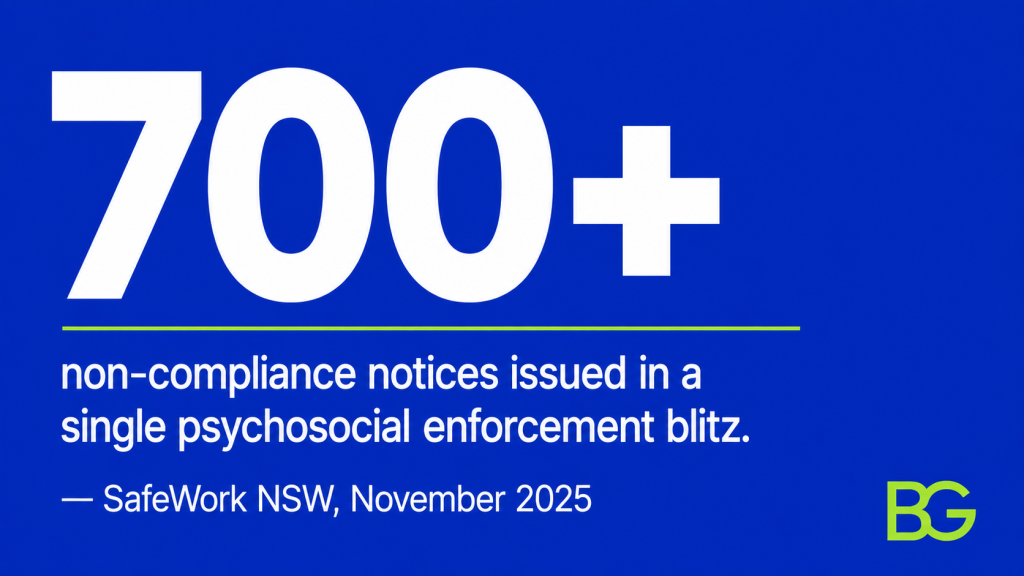
Reporting by the law firm Gadens (read the briefing) in March 2026 confirmed what many workplace health and safety practitioners had been anticipating: SafeWork NSW has made a permanent structural shift in its psychosocial enforcement approach. The regulator has appointed 20 inspectors with a specific psychosocial mandate — dedicated roles that did not exist in their current form two years ago. A compliance blitz conducted in November 2025 resulted in more than 700 non-compliance notices, including 228 psychosocial-specific checks. And SafeWork has publicly stated it anticipates future prosecutions.
This is not a pilot program. This is the new psychosocial enforcement standard for New South Wales — and the pattern it represents is being replicated by regulators across Australian jurisdictions.
In this article, you will learn:
- What SafeWork NSW’s enforcement actions since 2025 tell us about where psychosocial enforcement is heading
- What regulators are specifically looking for when they assess psychosocial risk compliance
- Why having a psychosocial risk policy is not the same as having psychosocial risk management
- What Gallup’s 2026 global research says about the management gap that regulators are now targeting
- What employers need to do to be genuinely compliant — not just documentarily compliant
What SafeWork NSW’s Psychosocial Enforcement Shift Looks Like
The Gadens briefing documents a sequence of enforcement activity that represents a shift from reactive to proactive psychosocial enforcement. Prior to 2025, psychosocial risk enforcement in Australia was largely complaint-driven — regulators became involved when something had already gone wrong. The November 2025 blitz changed the pattern.
Twenty dedicated inspectors, each specifically focused on psychosocial hazards, were deployed across NSW workplaces. The blitz generated over 700 non-compliance notices — not all specific to psychosocial risk, but with 228 psychosocial-specific checks conducted as part of the exercise. SafeWork has indicated explicitly that this enforcement activity is intended to precede prosecution action: organisations that received notices and did not remediate will be the first prosecution targets.
The significance of appointing 20 permanent inspectors with a psychosocial mandate — rather than deploying existing WHS inspectors as needed — is that it signals institutional commitment. This is not a one-off compliance campaign. It is a structural psychosocial enforcement capability that will be ongoing.

What Regulators Are Actually Looking for in Psychosocial Enforcement
The most important misunderstanding Australian employers have about psychosocial risk compliance is the belief that having a policy satisfies the obligation. It does not.
When a SafeWork NSW inspector examines psychosocial risk in a workplace, they are not there to audit a folder. They are there to understand what actually happens inside that team. Do managers recognise psychosocial hazards when they present? Do they know how to respond when an employee discloses a psychological risk? Is there a genuine process for identifying and controlling psychosocial hazards — or is there a document that describes one? These are different things, and the inspector is trained to determine which one they are looking at.
The specific hazards being examined include those legislated under the Work Health and Safety Regulation 2017: role overload, poor role clarity, bullying and harassment, exposure to traumatic events, inadequate support from management, and poor organisational change management, among others. Having a procedure that nominates each of these hazards is not compliance. Compliance is demonstrated by showing what the organisation actually does to prevent them — and what managers actually do when employees are affected.
This is where the gap between documentary compliance and genuine compliance becomes legally significant. An organisation with a 50-page psychosocial risk management plan and managers who have never been trained in how to respond to a distressed employee is not compliant. It is exposed.
The Broader Pattern
Gallup’s 2026 State of the Global Workplace report frames the management gap that regulators are now targeting with precision. Despite approximately $40 billion in enterprise AI investment globally, 89% of executives report no measurable improvement in labour productivity. The reason Gallup identifies is not the technology. It is the manager — specifically, a global manager population that is increasingly disengaged, undertrained, and operating without the behavioural awareness to do the human parts of leadership well.
The same managerial deficit that prevents organisations from benefiting from AI investment is the one that creates psychosocial risk. When managers lack the skills and awareness to notice when a team member is psychologically at risk, to respond to disclosed distress, or to prevent harm through early intervention — the harm accumulates. It becomes a workers’ compensation claim. It becomes a non-compliance notice. And it becomes a prosecution.
Gallup’s data shows manager engagement has collapsed 9 points since 2022. In organisations where managers are disengaged, the likelihood of unaddressed psychological harm increases significantly. This is the pattern SafeWork NSW is now equipped and mandated to find.
What Employers Need to Do Differently Under the New Psychosocial Enforcement Regime
The practical implication of SafeWork NSW’s enforcement shift is that risk management in this space must now be behaviour-focused, not document-focused. A psychosocial risk register that identifies 16 hazard categories without connecting them to actual management behaviours and actual control mechanisms is not adequate.
What genuine compliance looks like is: managers who are trained not just in recognising psychosocial hazards but in responding to them — who know what to do when someone presents with distress, who understand their duty to intervene early, and who have been assessed and supported in developing that capability. It looks like monitoring systems that are sensitive to the early indicators of psychosocial harm — not just lagging indicators like compensation claims, but the leading indicators that precede them. It looks like a culture where raising a concern is treated as a signal to investigate, not a problem to manage.
Organisations that have invested heavily in policy but not in manager capability are the organisations SafeWork’s 20 inspectors will identify as non-compliant. The enforcement focus is on the behavioural gap — the space between what the policy says should happen and what managers actually do.
Conclusion
SafeWork NSW has made a deliberate, structural, and permanent shift in its psychosocial enforcement. Seven hundred non-compliance notices, 20 dedicated inspectors, and an explicit statement of forthcoming prosecutions is not ambiguous communication. It is a clear signal that the compliance standard has risen — and that organisations that treat psychosocial risk as a documentation exercise rather than a management imperative are now facing regulatory consequences.
The obligation has not changed. What has changed is the enforcement capacity to find those who are not meeting it. Prevention — genuine prevention, grounded in manager behaviour rather than policy documents — is the only strategy that addresses the regulatory exposure and the human harm at the same time.
Are Your Managers Actually Equipped to Manage Psychosocial Risk?
A psychosocial risk policy is not the same as psychosocial risk management. Bill helps organisations understand the gap between their documentation and their management culture — and what to do about it.