


Introduction
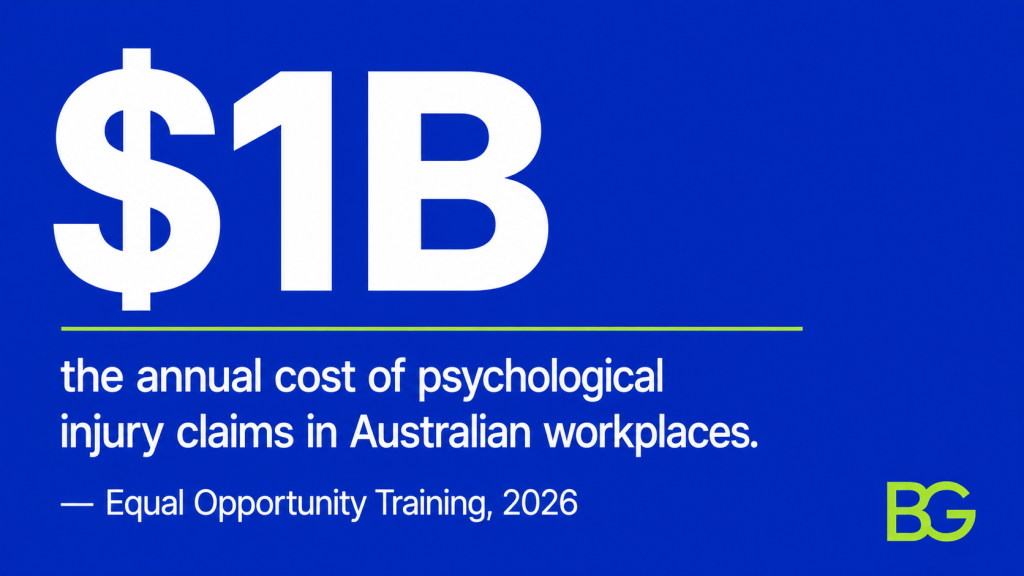
Australian workplaces are paying $1 billion a year in psychological injury claims caused by bad behaviour. Most of it starts with one leader who doesn’t know themselves.
New analysis reported by Equal Opportunity Training and The Times Australia in May 2026 confirms that psychological injury claims now cost Australian organisations over $1 billion annually. That figure has grown 161% in the past decade. Psychological injuries now result in nearly five times longer off-work periods compared to physical injuries. And workplace bullying — a behaviour-generated harm — now accounts for 39.5% of all active workers’ compensation claims, up more than 75% in the past year alone.
In this article, you will learn:
- The key figures driving the psychosocial claims cost in Australia
- Why the trajectory shows no sign of reversing under current management approaches
- The specific behavioural drivers behind the volume of claims
- What Gallup’s 2026 global research adds to the picture
- Why the cost of not knowing your leadership team’s behavioural patterns is now quantifiable
What the Psychological Injury Claims Data Actually Shows
The numbers reported in May 2026 by Equal Opportunity Training represent a decade of escalation, not a temporary spike.
$1 billion annually in psychological injury claims. A 161% increase over ten years. Claims resulting in recovery periods nearly five times longer than physical injuries. Workplace bullying accounting for more than a third of all active compensation claims — and growing.
These figures represent the accumulated cost of organisations that have invested in culture surveys but not in behavioural insight. Of management teams that know the language of psychological safety but do not understand what psychological harm looks like in a one-on-one meeting, a performance conversation, or a team debrief.
The numbers do not appear from nowhere. They appear because people are being harmed in specific, identifiable ways — and the leaders responsible for the harm do not know what they are doing.

The Behaviour Driving Psychological Injury Claims
Workplace bullying is not a force of nature. It is behaviour — specific, observable, measurable behaviour, and that behaviour is what turns into psychological injury claims. The research consistently points to the same traits as drivers: patterns of control, dominance, status protection, low empathy, and avoidance of accountability in leaders and managers.
These are not rare pathological profiles. They are traits that sit on a spectrum in virtually every leadership population. What determines whether they cause harm is whether the organisation has created the conditions for them to operate unchecked — whether there are mechanisms to make those patterns visible before they accumulate into a compensation claim.
The $1 billion in psychological injury claims is the outcome of organisations that have not built those mechanisms. That have treated culture as something measured in annual surveys rather than something managed in daily leadership behaviour.
The Broader Pattern
The Australian figure sits within a global picture of disengagement and leadership failure documented by Gallup’s 2026 State of the Global Workplace report. Globally, only 20% of workers are engaged — the lowest since 2020. The report estimates disengagement and management failure costs approximately $10 trillion in lost productivity annually worldwide — manager engagement has collapsed nine points since 2022. The research is direct: the primary driver of both engagement and psychological safety is manager behaviour. When that behaviour is not understood, not developed, and not measured, the downstream cost — in Australia, $1 billion a year in psychological injury claims — is the predictable outcome.
In Australia and New Zealand specifically, 49% of workers experienced significant daily stress in the past year. That is nine points above the global average. These workers are not in unusual circumstances. They are working in ordinary Australian organisations under ordinary Australian managers.
The Question Every Leader Needs to Ask About Psychological Injury Claims
The data makes the cost visible. But the cost is only addressable if you can identify the behaviour producing it — specifically, in your organisation, in your leadership team.
Most organisations cannot do that. Not because the information is unavailable, but because no one has built the measurement framework to surface it. Engagement surveys measure outputs. Performance reviews measure tasks. Neither captures the interpersonal patterns that determine whether a person comes to work feeling safe or spends the night dreading tomorrow.
Behavioural psychometric tools designed for this purpose — like the Entrepleio® assessment — are built to surface precisely those patterns. Not to label leaders as problems, but to create visibility where there is currently none. The return on that investment is measurable: reduced claim exposure, improved retention, demonstrable compliance, and leadership teams that understand themselves well enough to stop generating the $1 billion bill.
Conclusion
The $1 billion in psychological injury claims is not an abstraction. Each dollar represents a person who was harmed by behaviour that an organisation failed to see, name, or interrupt. The trajectory — up 161% in a decade, still climbing — tells you that the current approach to culture management is not working.
The starting point for a different outcome is making leadership behaviour visible. Not after the claim. Before the conversation where someone decides whether to come back to work tomorrow.
Is Your Organisation Contributing to the $1 Billion Bill?
The cost of psychological injury in Australian workplaces is quantifiable. What is not yet visible in most organisations is the leadership behaviour driving it. That is exactly what Entrepleio® is built to reveal.