

Introduction
Sexual harassment remains a workplace culture problem, not just a policy one — and it’s still affecting one in five Australian workers. New research confirms that policy alone is not the answer — culture is.
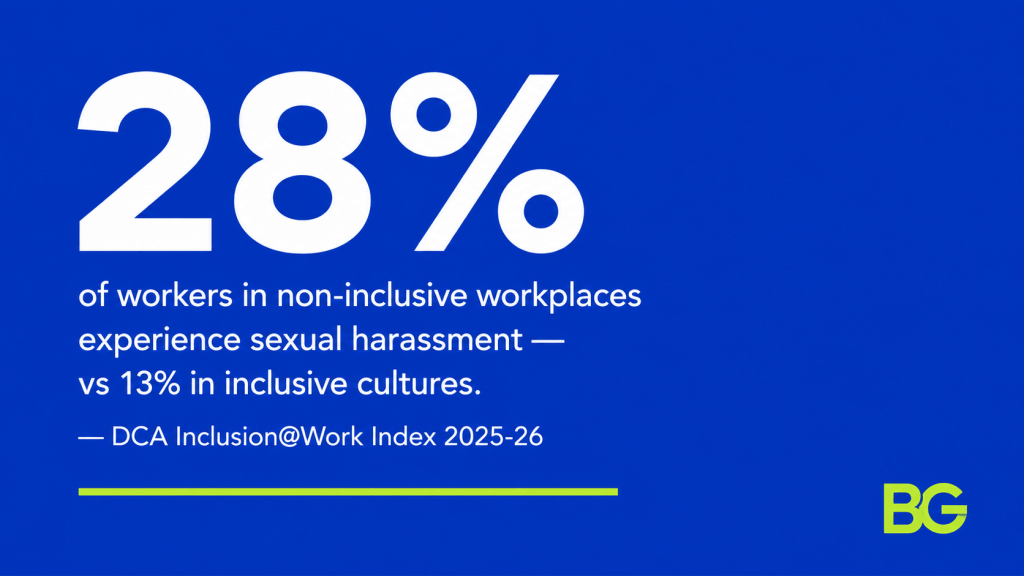
The Diversity Council Australia’s 2025–2026 Inclusion@Work Index — based on responses from 3,000 Australian workers — found that 18% experienced sexual harassment in the past 12 months. That is a significant figure. But what is more significant is what the same research found about the culture variable: in workplaces rated as inclusive, harassment rates drop to 13%. In workplaces rated as non-inclusive, they double to 28%.
The difference between 13% and 28% is not explained by policy differences. It is explained by culture — the daily lived experience of whether people in an organisation are seen, respected, and treated as fully human at work.
In this article, you will learn:
- What the DCA’s 2026 data reveals about sexual harassment prevalence and drivers
- Why the gap between inclusive and non-inclusive workplace harassment rates matters more than the overall figure
- How this reinforces the central argument for culture-first, behaviour-first prevention
- What Gallup’s 2026 global research adds to the picture of workplace respect and safety
- What leaders need to understand about culture as an active safety variable
What the DCA Research Found About Sexual Harassment and Culture
The Diversity Council Australia’s Inclusion@Work Index is one of Australia’s most credible and longitudinal workplace inclusion surveys. The 2025–2026 edition — based on 3,000 worker responses across sectors — confirmed that sexual harassment remains pervasive in Australian workplaces, with 18% of respondents reporting experience of it in the preceding twelve months.
Reporting by HRD Australia in May 2026 highlighted the key finding: the culture differential. An 18% overall rate sits inside a range of 13% to 28% depending on whether the workplace is rated as inclusive or non-inclusive. That 15-percentage-point gap is culture-attributable — it cannot be explained by sector, size, geography, or policy variation. It is the difference that culture makes.

The Culture Variable
The DCA data confirms something that organisations designing compliance-based prevention programs frequently resist: policy does not change behaviour. Culture does.
A harassment policy establishes what is formally prohibited. Culture establishes what is actually tolerated, named, interrupted, and addressed. In a genuinely inclusive culture — one where people feel safe to name harmful conduct, where leadership models respect, where reports are handled without penalising the reporter — harassment rates are lower. Not because the policy is better. Because the environment makes it harder for harmful behaviour to operate without interruption.
In non-inclusive cultures, the reverse is true. Harmful behaviour finds the gaps. The absence of interruption becomes permission. The 28% harassment rate in non-inclusive workplaces is not the result of more harassers being present — it is the result of a culture where harassment encounters fewer obstacles.
This is the core argument for culture work: you cannot compliance-engineer your way out of a culture problem tied to sexual harassment. You have to change the culture.
The Broader Pattern
The DCA finding sits within a global picture of declining workplace safety and respect. Gallup’s 2026 State of the Global Workplace report found that 22% of workers globally experienced being treated with disrespect the previous day — a figure that sits alongside elevated rates of anger (22%), sadness (23%), and loneliness (22%) across the workforce.
These are not incidental numbers. They are the cumulative output of organisational cultures where leadership behaviour — including tolerance of harassment, exclusion, and disrespect — has not been actively addressed.
In Australia specifically, 49% of workers experienced significant daily stress in the past year — the second highest stress rate among developed nations in the Gallup data. The correlation between high-stress work environments and elevated harassment rates is well-documented. Stress degrades the cultural norms that ordinarily restrain harmful behaviour. Which means high-stress cultures are also higher-risk harassment cultures.
What Changes When Culture Is the Strategy
Organisations that approach sexual harassment prevention as a culture project — rather than a compliance project — make a different set of investments.
They invest in understanding the leadership behaviour that sets the daily cultural tone: how inclusion is modelled, how disrespect is named and responded to, what signals leaders send about whose experience counts. They invest in the capability of managers to identify and interrupt harmful dynamics before they become reportable conduct. They invest in making the behavioural patterns that enable or suppress harassment visible — to leaders themselves, not just to HR departments.
This is exactly the territory that behavioural consulting and structured psychometric assessment addresses. Understanding what traits are active in a leadership team — and how those traits affect the inclusivity of the culture around them — gives organisations the information they need to prevent harm, not just process it after the fact.
Conclusion
Eighteen percent is too high. And it is preventable — not through a better policy, but through a workplace culture where sexual harassment encounters interruption rather than tolerance.
The DCA data is clear: inclusive culture reduces harassment by nearly half. That makes culture the most powerful anti-harassment tool available to Australian organisations. And culture starts with leadership behaviour — the patterns leaders model, tolerate, and reward every day.
The question for every Australian leader is not whether their organisation has a harassment policy. It is whether their culture makes harmful behaviour harder to do.
Does Your Culture Make Harmful Behaviour Harder to Do?
The DCA research confirms it: culture is the variable that matters. Bill works with leadership teams to build the inclusive, behaviour-aware cultures that protect people — and organisations. The conversation starts here.