


Introduction
Reporting is up. Confidence in reporting systems is rising. And workplace misconduct is near a seven-year high. These workplace misconduct reporting facts sit together — and the conclusion they point to is uncomfortable.
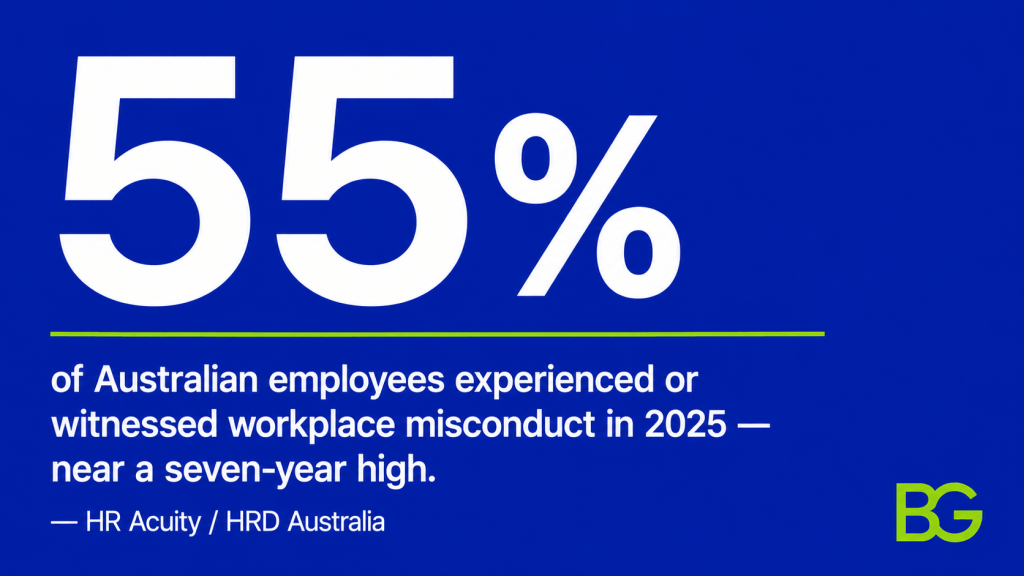
HR Acuity data reported by HRD Australia in May 2026 confirms that 55% of Australian employees either experienced or witnessed workplace misconduct in 2025. That is up from 41% in 2024 — the highest figure in nearly seven years. Of those who witnessed misconduct, 78% reported it. Confidence in reporting mechanisms is, by those measures, improving.
But the misconduct generating those reports has not decreased. It has increased.
In this article, you will learn:
- What the HR Acuity 2025 data shows about misconduct prevalence and reporting trends
- Why improved reporting systems can coexist with worsening culture — and why this matters
- What the pressure wave looks like for leaders and HR teams as report volumes grow
- How global and Australian data confirm this is a systemic, not individual, pattern
- What the only durable intervention looks like at the leadership level
What the Workplace Misconduct Reporting Data Shows
The HR Acuity data, as reported by HRD Australia in May 2026, documents a significant escalation in misconduct across the Australian workforce over a 12-month period.
In 2024, 41% of Australian employees experienced or witnessed misconduct. In 2025, that figure rose to 55% — a 14-percentage-point increase in a single year, pushing the rate to its highest level in nearly seven years. The categories driving the increase include harassment, bullying, discrimination, and conduct that generates formal complaints.
At the same time, reporting confidence is at a high. Seventy-eight percent of employees who witnessed misconduct reported it — a figure that reflects years of investment in anonymous reporting tools, speak-up culture messaging, and complaints infrastructure.
The problem is that the infrastructure is now receiving more volume than it was designed to process. And the culture generating the volume is not being changed by the receipt of the reports.

Better Reporting Systems, Same Broken Culture
This is the central paradox in the current data: organisations have built better systems for capturing misconduct without building better cultures for preventing it.
A well-functioning reporting system is genuinely important. People who are harmed should have safe, accessible pathways to report that harm. But reporting systems are reactive instruments. They activate after misconduct occurs. Their existence does not reduce the frequency of the conduct — it increases the visibility of it.
When an organisation improves its reporting infrastructure without also changing the cultural conditions that produce the misconduct, the result is a more accurate picture of the culture’s actual state. The reports are not increasing because misconduct is suddenly more common. They are increasing because people now believe — more than they did before — that reporting is worth doing.
That is progress. But it is not a culture improvement. It is a symptom count.
The Broader Pattern
The Australian misconduct data sits within the global picture documented by Gallup’s 2026 State of the Global Workplace report. Globally, employee engagement has fallen to 20% — the lowest since 2020. Disrespect, anger, sadness, and loneliness are elevated above pre-pandemic levels across the workforce.
In Australia and New Zealand, 49% of workers reported significant daily stress. Job market optimism fell 12 points in a single year — the sharpest regional decline globally. These figures describe a workforce that is experiencing increasing harm, increasingly willing to report it, and working within organisations that are not yet addressing its root causes.
The root cause is not anonymous or abstract. It is leadership behaviour — the specific patterns of conduct by managers and senior leaders that either generate or interrupt the conditions in which misconduct thrives.
What the Pressure Wave Looks Like for Leaders
The escalating report volume has concrete organisational consequences that go beyond the individual misconduct cases being processed.
Every formal misconduct report triggers an investigation process. Investigation processes consume HR capacity, management time, and legal resources. When report volumes increase by 34% in a single year, organisations that have not scaled their investigation infrastructure face a choice: under-investigate (and increase liability) or over-resource (and direct attention away from prevention).
Neither outcome changes the culture producing the reports.
The organisations that will navigate this period differently are those that shift investment from reactive investigation to preventive culture work — specifically, to the behavioural assessment and development of leadership cohorts. Understanding which traits in which leaders are creating the conditions for misconduct is the first step toward reducing the volume of reports, rather than processing it more efficiently.
This is the conversation that structured behavioural consulting opens — not a training course or a workshop, but a genuine behavioural assessment of what is active in the leadership culture and what needs to change.
Conclusion
Fifty-five percent is not just a workplace misconduct reporting problem. It is a culture problem that reporting systems are now making visible.
The response that will change the trajectory is not a better complaints form. It is an honest assessment of the leadership behaviours driving the misconduct — and a genuine investment in changing them.
Reporting going up means people are trusting the systems more. The next step is building an organisation where there is less to report.
Is Your Organisation Addressing the Cause — or Just Processing the Reports?
Reporting is up across Australia. The cultures producing the reports are not changing. Bill works with leaders and organisations to address the behavioural root cause — not the symptom count. The starting point is understanding what’s actually happening inside your leadership culture.